Understanding Bite Misalignment: Overbite vs. Overjet
Many individuals wish to correct an overbite but are hesitant about surgical options. We understand this concern. Modern orthodontics offers effective ways to achieve a harmonious smile and a healthy bite without invasive procedures.
An overbite, where your upper front teeth excessively overlap your lower front teeth, is more than just a cosmetic issue. If left untreated, it can lead to various oral health problems, including jaw discomfort, uneven tooth wear, and even speech difficulties.
In this extensive guide, we will explore non-surgical overbite correction. We will delve into how modern orthodontics can achieve a balanced, healthy smile through advanced techniques, including those focused on facial-driven smile design. Join us as we uncover the causes, classifications, and a range of effective treatments available today, setting realistic expectations for adults and highlighting the importance of long-term retention.
When discussing bite issues, it’s crucial to distinguish between an overbite and an overjet, as they represent different types of dental malocclusion. An overbite refers to the vertical overlap of your upper front teeth over your lower front teeth. In a healthy bite, a slight overbite, typically between 2 to 4 millimeters, is considered normal and necessary for proper chewing function and tooth protection. This slight overlap ensures that the upper and lower teeth meet efficiently when you bite down. When this vertical overlap exceeds the normal range, it’s classified as a deep overbite, indicating a malocclusion that may require intervention.
In contrast, an overjet refers to the horizontal protrusion of the upper front teeth beyond the lower front teeth. While often confused, overjet describes how far forward your upper teeth extend compared to your lower teeth, creating a “buck teeth” appearance in severe cases. Overbite is about vertical coverage, while overjet is about horizontal projection. Both can occur simultaneously, but they are distinct measurements of how your upper and lower jaws and teeth align.
Untreated overbites can lead to a cascade of symptoms and complications that extend beyond aesthetics. The excessive vertical overlap can cause the lower front teeth to bite into the gum tissue behind the upper front teeth, leading to gum recession, chronic irritation, and even periodontal disease. The constant friction can also result in significant tooth erosion on the chewing surfaces of the lower front teeth and the back surfaces of the upper front teeth. This wear can expose the sensitive dentin layer, leading to increased sensitivity, chipping, and even tooth loss over time.
Beyond dental issues, a deep overbite can contribute to temporomandibular joint disorders (TMD), manifesting as jaw pain, clicking or popping sounds in the jaw, headaches, and difficulty opening or closing the mouth comfortably. Speech challenges, particularly with sibilant sounds, can also arise due to improper tongue placement and tooth alignment. In some cases, breathing issues, especially during sleep, have been linked to severe malocclusions.
The causes of an overbite are multifaceted, often stemming from a combination of genetic, developmental, and habitual factors. Genetic factors play a significant role, as jaw shape and size are inherited. If parents or close relatives have a deep overbite, there’s a higher likelihood that their children will too. Developmental factors include discrepancies in jaw growth, where the upper jaw grows disproportionately to the lower jaw, or vice versa.
Habitual factors are particularly common in childhood and can significantly influence jaw and tooth development. Prolonged thumb sucking or pacifier use past the age of three can exert pressure on the developing jaws and teeth, pushing the upper front teeth forward and preventing the lower jaw from growing adequately. Tongue thrusting, where the tongue pushes against the front teeth during swallowing, can also contribute to an overbite. Other habits like excessive nail biting or teeth grinding (bruxism) can exacerbate existing bite issues or contribute to their development. Early loss of baby teeth can also disrupt the natural spacing and eruption of permanent teeth, potentially leading to malocclusion.
Facial-Driven Orthodontic Treatments for Overbite Correction
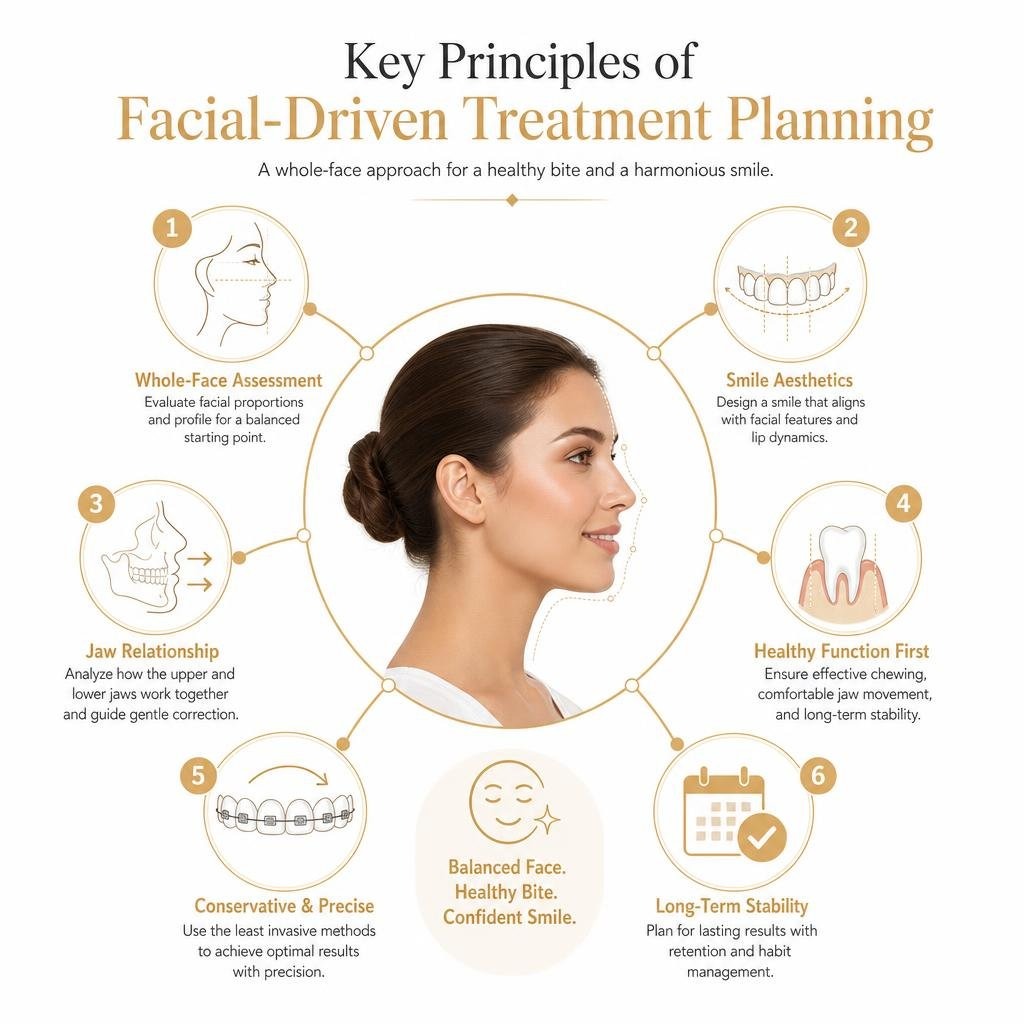
Modern orthodontics has evolved beyond merely straightening teeth; it now embraces a comprehensive approach known as facial-driven treatment. This philosophy prioritizes not only the alignment of teeth but also their harmonious relationship with the patient’s overall facial aesthetics and soft tissue profile. When correcting an overbite, a facial-driven approach considers how tooth movement and jaw repositioning will impact the lips, nose, chin, and overall facial balance. This holistic perspective ensures that the final result is not just a perfectly aligned bite, but a smile that complements and enhances the entire face.
The diagnosis of an overbite involves a thorough assessment by an orthodontist, who will classify it based on its origin: dental or skeletal. A dental overbite occurs when the teeth themselves are misaligned, leading to excessive vertical overlap, even if the jawbones are relatively well-positioned. This type often responds well to tooth movement alone. A skeletal overbite, on the other hand, involves a discrepancy in the size or position of the upper and lower jawbones, where the upper jaw might be too far forward or the lower jaw too far back. Skeletal overbites are typically more complex and may require more advanced non-surgical techniques or, in very severe cases, surgical intervention (though we are focusing on non-surgical here).
Diagnostic Approaches in Facial-Driven Orthodontic Treatments
To accurately diagnose and plan treatment for an overbite, particularly from a facial-driven perspective, orthodontists employ a range of sophisticated diagnostic tools.
- Physical Exam: A visual and tactile examination of the teeth, gums, and jaw movements.
- Dental X-rays: Periapical, panoramic, and cephalometric X-rays provide detailed images of the teeth, roots, jawbones, and surrounding structures. Cephalometric analysis, in particular, is crucial for assessing skeletal classification and growth patterns, allowing the orthodontist to measure angles and distances between various facial landmarks.
- Digital 3D Imaging: Advanced technologies like cone-beam computed tomography (CBCT) create detailed 3D models of the patient’s oral and maxillofacial structures. This allows for precise visualization of bone density, root positions, and jaw relationships, aiding in the planning of complex tooth movements.
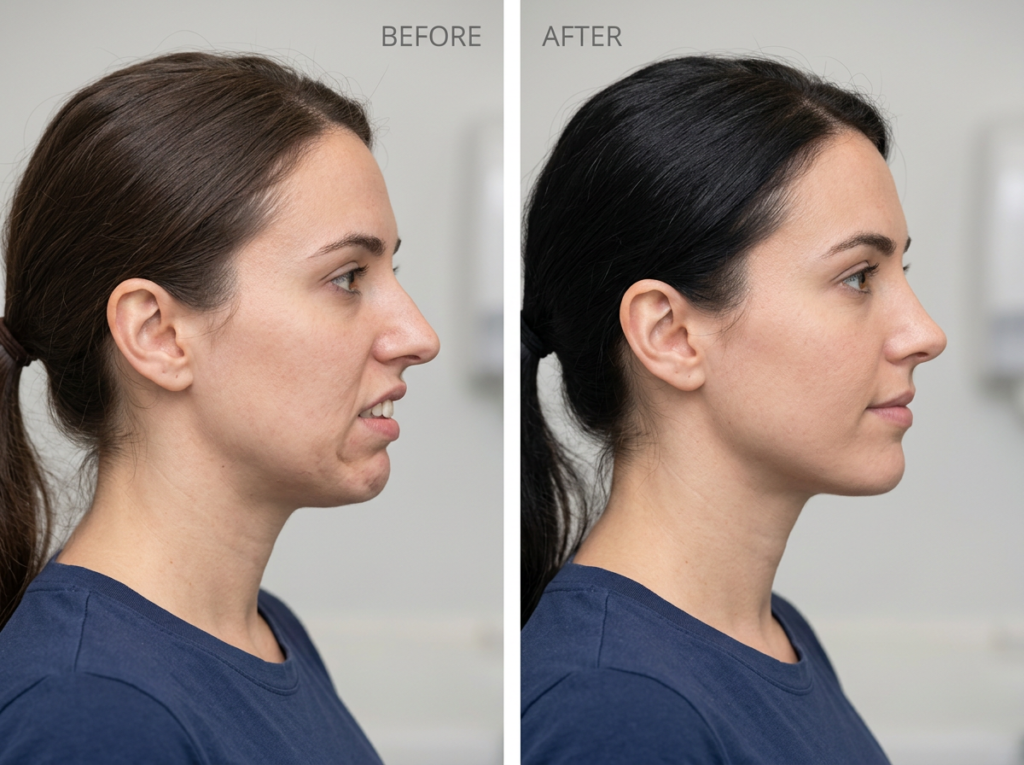
- Facial Profile Analysis: This involves evaluating the patient’s facial features from a side view to assess the relationship between the nose, lips, and chin. It helps determine how changes in bite alignment will affect the overall facial balance and aesthetics.
- Lip Support Evaluation: Assessing how the teeth and jaws support the lips is vital for achieving a natural and aesthetically pleasing smile. Proper lip support contributes to a youthful appearance and comfortable lip posture.
- Study Models/Digital Scans: Impressions or digital scans of the teeth create models that allow the orthodontist to analyze the bite in detail and plan tooth movements.
These diagnostic tools collectively enable the orthodontist to develop a personalized treatment plan that addresses both the dental and skeletal components of the overbite, with a strong emphasis on achieving optimal facial harmony.
Treatment Modalities in Facial-Driven Orthodontic Treatments
For non-surgical overbite correction, particularly in the context of facial-driven orthodontics, several innovative treatment modalities are available:
- Traditional Braces: While often associated with comprehensive tooth movement, modern braces with advanced archwire technology can effectively intrude (push up) anterior teeth and extrude (pull down) posterior teeth to correct vertical overlap.
- Clear Aligners (e.g., Invisalign): These custom-made, removable plastic aligners are increasingly effective for mild to moderate overbites. They can achieve significant intrusion of anterior teeth and allow for controlled bite correction.
- Miniscrews (Temporary Anchorage Devices – TADs): These tiny, temporary implants placed in the bone provide stable anchorage points for orthodontic forces. Miniscrews are in their ability to achieve significant tooth movement, such as molar intrusion or distalization (moving molars backward), which can open the bite and reduce overbite without relying on patient compliance with headgear. Miniscrew-assisted orthodontics has enabled stable nonsurgical correction even in severe deep overbite and high-angle skeletal Class II cases, with outcomes reported as comparable to surgery and treatment time around 3.5 years including retention.
- Palate Expanders: Primarily used in growing children, these devices widen the upper jaw to create more space and correct crossbites, which can sometimes be a component of an overbite. In adults, surgically assisted rapid palatal expansion (SARPE) can be considered, but non-surgical expansion is generally limited to younger patients or specific scenarios with miniscrew assistance.
- Functional Appliances: These removable or fixed devices are primarily used in growing patients to modify jaw growth. They work by posturing the lower jaw forward, encouraging its development and helping to reduce a skeletal overbite. Examples include Herbst appliances or Forsus appliances. While most effective during growth spurts, some functional appliances can be used in adults to retrain jaw muscles.
- Myofunctional Therapy: This involves exercises to correct improper tongue posture, swallowing patterns, and other oral habits. By retraining the muscles of the face and mouth, it can support orthodontic treatment and help stabilize results, particularly in cases where habits like tongue thrusting contributed to the overbite.
Here is a list of facial-driven non-surgical interventions:
- Orthodontic Braces (traditional, self-ligating)
- Clear Aligner Systems (e.g., Invisalign)
- Miniscrews (Temporary Anchorage Devices – TADs)
- Palate Expanders (especially for growing patients, sometimes miniscrew-assisted for adults)
- Functional Appliances (e.g., Herbst, Forsus)
- Myofunctional Therapy
- Interproximal Reduction (IPR)
- Elastics/Rubber Bands
These treatment modalities, when applied judiciously and often in combination, allow orthodontists to achieve remarkable non-surgical overbite correction, focusing on both dental health and optimal facial aesthetics.
Comparing Non-Surgical Options: Braces, Clear Aligners, and Functional Therapy
When exploring non-surgical options for overbite correction, patients often weigh the pros and cons of traditional braces, clear aligners, and functional appliances, sometimes complemented by myofunctional therapy. Each approach offers distinct advantages and considerations.
Traditional Braces remain a highly effective and versatile option. Comprising metal or ceramic brackets bonded to the teeth and connected by archwires, braces provide continuous, controlled force to move teeth into their ideal positions. They are particularly adept at handling complex tooth movements, including significant intrusion of anterior teeth and extrusion of posterior teeth needed for deep overbite correction. The orthodontist has precise control over each tooth’s movement, making them a reliable choice for severe overbites. However, they are fixed, can be more noticeable, and require diligent oral hygiene.
Clear Aligners, such as Invisalign, offer a more discreet alternative. These custom-made, removable plastic trays gradually shift teeth into alignment. For overbite correction, aligners can be designed to intrude the front teeth and extrude the back teeth, effectively opening the bite. They are generally effective for mild to moderate dental overbites. A significant advantage is their removability, allowing for easier eating and oral hygiene. However, their success heavily relies on patient compliance, as aligners must be worn for 20-22 hours per day. For more severe skeletal overbites or complex movements, traditional braces or a combination approach might be more suitable.
Lingual Braces are another discreet option, similar to traditional braces but bonded to the inside (lingual) surface of the teeth, making them virtually invisible from the outside. They offer the same level of control as conventional braces but can be more challenging to adjust and clean, and may initially affect speech.
Functional Appliances are primarily designed to modify jaw growth and are most effective in growing children and adolescents. These appliances, which can be removable or fixed, encourage the lower jaw to grow forward, helping to correct skeletal overbites. While their role in adults is more limited to retraining muscles or minor adjustments, they are invaluable for interceptive orthodontics.
Myofunctional Therapy focuses on correcting improper oral muscle function and habits like tongue thrusting or mouth breathing. By retraining the muscles of the face, tongue, and mouth, it can help stabilize orthodontic results, improve breathing, and support proper jaw development. It’s often used in conjunction with other orthodontic treatments to address the underlying causes of malocclusion and prevent relapse. Habit correction, such as discouraging thumb-sucking in young children, is a preventative measure that falls under this umbrella.
Here’s a comparison of these options:
Feature Traditional Braces Clear Aligners (e.g., Invisalign) Functional Appliances (e.g., Herbst) Visibility Visible (metal/ceramic) Nearly invisible Variable (can be visible or mostly internal) Removability Fixed Removable Variable (removable or fixed) Effectiveness Highly effective for all overbite types Effective for mild to moderate dental overbites Highly effective for skeletal overbites in children Compliance Requires good oral hygiene High patient compliance (20-22 hrs/day) required Variable, depending on fixed or removable appliance Comfort Initial discomfort, occasional irritation Generally comfortable, some initial pressure Can be bulky, may affect speech/eating initially Maintenance Careful cleaning around brackets Easy to clean teeth, aligners need daily cleaning Requires careful cleaning, especially fixed types Cost Moderate to High High Moderate (often part of a two-phase treatment) Typical Use Comprehensive tooth movement, severe cases Discreet correction, minor to moderate cases Jaw growth modification in growing patients The choice of treatment depends on the severity and type of overbite (dental vs. skeletal), the patient’s age, lifestyle, aesthetic concerns, and commitment to compliance. A thorough consultation with an orthodontist will determine the most appropriate and effective non-surgical approach.
Non-Surgical Timelines, Adult Expectations, and Retention
The duration of non-surgical overbite correction can vary significantly depending on the severity of the malocclusion, the chosen treatment method, and individual patient factors. Generally, for comprehensive orthodontic treatment, including overbite correction, the treatment duration typically ranges from 2 to 3 years. However, as noted by clinician-reported outcomes, many treatments are completed within this timeframe, achieving 95 to 100 percent resolution in hundreds of cases.
For more complex cases, particularly those utilizing advanced techniques like miniscrew-assisted orthodontics for severe deep overbite and high-angle skeletal Class II cases, the treatment time can extend to around 3.5 years, including the retention phase. This longer timeline reflects the intricate tooth movements and skeletal changes being achieved without surgery.
When considering non-surgical overbite correction in adults, it’s important to have realistic expectations. While children and adolescents benefit from softer, more pliable jawbones that are still growing, adult jaw bone density is greater, meaning tooth movement can be slower and may require more consistent force. However, advancements in orthodontic technology, including new bracket designs, archwire materials, and the use of miniscrews, have made non-surgical correction of even complex adult overbites highly achievable. Adults can absolutely correct an overbite without surgery, but the process might take slightly longer than in a growing patient, and the scope of skeletal change without surgery is naturally limited compared to surgical options.
The role of retainers and habit correction in maintaining results cannot be overstated. Orthodontic treatment moves teeth into new positions, but without proper retention, they have a natural tendency to drift back towards their original alignment. This phenomenon is known as relapse. Retainers are custom-made devices, either removable (like clear plastic aligners or Hawley retainers) or fixed (a thin wire bonded to the back of the front teeth), designed to hold the teeth in their corrected positions until the surrounding bone and soft tissues stabilize.
Compliance with retainer wear is critical for long-term stability. Research indicates that poor compliance, specifically wearing retainers below 18 hours per day, is associated with a significant 30 to 40 percent relapse rate. This statistic underscores the importance of diligently following your orthodontist’s instructions regarding retainer wear, often for life, to protect your investment in a healthy, aligned smile.
Beyond retainers, addressing any contributing habits is equally vital. If habits like tongue thrusting or teeth grinding were factors in the original overbite, incorporating myofunctional therapy or using a night guard can prevent these habits from undermining the orthodontic results. Regular dental check-ups also allow your orthodontist to monitor your bite and retainer wear, making any necessary adjustments to ensure the long-term stability of your corrected overbite.
Frequently Asked Questions
How do facial-driven orthodontic treatments differ from traditional bite correction?
Facial-driven orthodontic treatments distinguish themselves by integrating facial aesthetics and soft tissue considerations into the treatment planning process, rather than focusing solely on tooth alignment. While traditional methods primarily aim for a functionally correct bite, a facial-driven approach evaluates how tooth and jaw movements will impact the overall facial profile, lip support, and smile harmony. This comprehensive perspective ensures that the final result is not just a healthy bite, but a smile that beautifully complements the entire face.
Can severe skeletal overbites in adults be corrected without surgery?
Yes, in many cases, even severe skeletal overbites in adults can be corrected without surgery, thanks to advancements in orthodontic technology. Miniscrew-assisted orthodontics (TADs) has been particularly transformative, providing stable anchorage to achieve significant tooth and jaw movements that were previously only possible with surgery. This allows for stable nonsurgical correction even in severe deep overbite and high-angle skeletal Class II cases. While there are limitations to non-surgical skeletal changes in adults compared to growing patients, modern techniques offer robust alternatives to surgery for many individuals.
What is the typical timeline for non-surgical overbite correction?
The typical timeline for non-surgical overbite correction generally ranges from 2 to 3 years. This duration can vary based on the complexity of the case, the patient’s age, and the chosen treatment method (e.g., braces, clear aligners). For more challenging cases, especially those involving miniscrew-assisted orthodontics, the treatment time might extend to approximately 3.5 years, which includes the crucial retention phase to ensure long-term stability. Consistent compliance with treatment protocols, such as wearing aligners or elastics as prescribed, can also influence the overall duration.
Conclusion
Correcting an overbite without surgery is not only possible but increasingly effective, thanks to the continuous evolution of orthodontic science and technology. We’ve explored how a deep overbite, a vertical misalignment of the teeth, can lead to significant oral health challenges if left unaddressed. Understanding the distinction between overbite and overjet, and recognizing the genetic, developmental, and habitual causes, is the first step toward seeking appropriate treatment.
Modern orthodontics, particularly through a facial-driven approach, offers a sophisticated pathway to achieve not just a healthy bite, but also enhanced facial aesthetics and a harmonious smile. With advanced diagnostic tools and a range of non-surgical modalities—including traditional braces, clear aligners, miniscrews, functional appliances, and myofunctional therapy—orthodontists can tailor personalized treatment plans for virtually any patient.
While treatment timelines can range from 2 to 3.5 years, especially with advanced techniques like miniscrew-assisted orthodontics, the outcomes are often comparable to surgical results for many severe cases. For adults, realistic expectations are key, acknowledging that tooth movement may be slower, but significant non-surgical correction is highly achievable. The long-term success of any overbite correction hinges critically on diligent retainer compliance and addressing any contributing habits.
Achieving a balanced, healthy bite and a beautiful smile is an investment in both your long-term oral health and overall well-being. If you suspect you have an overbite or are experiencing any related symptoms, we strongly encourage you to schedule a consultation with a qualified orthodontist. A specialist can provide a comprehensive diagnosis, discuss your personalized treatment options, and guide you on the path to a confident, healthy smile.