
Introduction
In this comprehensive guide, we will explore the fascinating science behind anti-aging health supplements. We’ll delve into how botanical ingredients, with a particular focus on the renowned Ayurvedic herb Guduchi (Tinospora cordifolia), contribute to cellular rejuvenation and immune longevity. We will discuss their mechanisms of action, primary benefits, and crucial considerations for safe and effective use. Our aim is to provide you with a clear, authoritative understanding of these powerful natural tools.
The Science Behind Anti-Aging Health Supplements and Immune Longevity
The concept of anti-aging extends beyond superficial appearances; it fundamentally involves maintaining robust cellular health and a well-functioning immune system. In this context, adaptogenic herbs like Guduchi, known in Hindi as Giloy and often referred to as ‘Amrita’ or ‘nectar of immortality’ in Sanskrit, hold significant promise. Guduchi (Tinospora cordifolia) is a cornerstone of Ayurvedic medicine, classified as a Rasayana, meaning it promotes rejuvenation and longevity. Its traditional uses are now increasingly supported by modern scientific inquiry, positioning it as a valuable component in the realm of scientifically backed health supplements.
Guduchi’s primary benefits revolve around its potent immunomodulatory properties. It doesn’t merely stimulate the immune system but rather helps to balance it, making it effective for both underactive and overactive immune responses. This balancing act is crucial for sustained health and resilience, particularly as we age. The herb is celebrated for its ability to bolster the body’s natural defenses, enhance the effectiveness of white blood cells, and support recovery from various infective conditions.
The Biological Mechanisms of Modern Anti-Aging Health Supplements
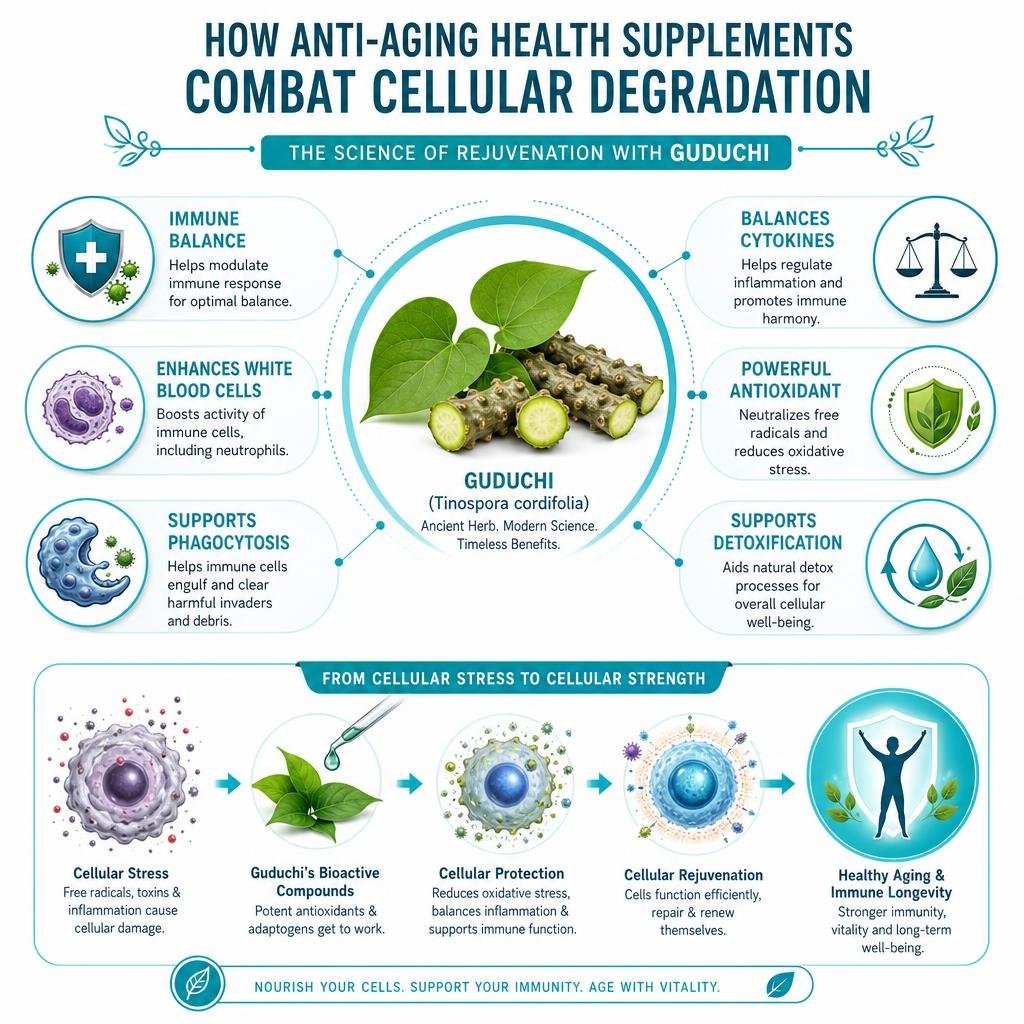
At a cellular level, Guduchi exerts its anti-aging and immune-supportive effects through several intricate biological mechanisms. One key area is its impact on white blood cells, which are the frontline defenders of our immune system. Research suggests that Guduchi enhances the activity of white blood cells, including neutrophils, which play a vital role in phagocytosis – the process by which immune cells engulf and destroy foreign particles, bacteria, and cellular debris. This improved cellular efficiency contributes to faster recovery from infections and a more robust immune response overall.
Furthermore, Guduchi contributes to healthy aging by helping to balance cytokine levels. Cytokines are signaling proteins that regulate inflammation and immune responses. An imbalance, particularly chronic low-grade inflammation, is a hallmark of aging (often termed “inflammaging”) and is linked to numerous age-related diseases. Guduchi’s anti-inflammatory properties help to modulate these responses, promoting systemic detoxification and reducing the burden on the body’s systems. Its rich antioxidant profile also aids in free radical scavenging, neutralizing harmful reactive oxygen species that contribute to cellular damage and accelerate the aging process. These combined actions support overall cellular health, making it a compelling ingredient in anti-aging strategies.
Evaluating Botanical Extracts in Anti-Aging Health Supplements
The efficacy of botanical extracts like Guduchi stems from their complex array of bioactive compounds. Among these, arabinogalactan polysaccharides are particularly noteworthy for their immunomodulatory actions. These compounds have been shown to stimulate various immune cells, including T-cells, which are critical for adaptive immunity. By enhancing T-cell activity, Guduchi helps the body mount a more effective and targeted response against pathogens.
Guduchi’s traditional use for fever management and post-viral recovery is also well-documented and supported by its biological actions. It is classified as an antipyretic herb, meaning it can help reduce fever. This makes it a valuable supplement during periods of illness, assisting the body in overcoming viral challenges and reducing associated symptoms. For instance, during the 2020-2022 global health crisis, the AYUSH Ministry in India recommended Guduchi for immune support, underscoring its relevance in contemporary health concerns. Its ability to support the body’s resilience during and after infections contributes significantly to maintaining overall vitality and preventing the chronic fatigue that can often follow such episodes.
Bioactive Phytoconstituents and Systemic Cellular Protection
The profound health benefits of Guduchi are attributed to a diverse range of bioactive phytoconstituents working in concert. These compounds provide systemic cellular protection, addressing various aspects of health and longevity.
Key compounds include diterpenoids such as tinosporide, cordifolide, and tinosporaside, along with alkaloids like berberine, magnoflorine, and palmatine. These molecules have been extensively studied for their pharmacological activities, which include immunomodulatory, anti-inflammatory, antioxidant, and hepatoprotective effects. For example, tinosporide contributes to its anti-inflammatory actions, while berberine is recognized for its metabolic benefits. These constituents work synergistically to protect cells from oxidative stress, reduce inflammation, and support the body’s natural repair mechanisms, all of which are vital for healthy aging.
Synergistic Botanical Formulations
In Ayurvedic practice, Guduchi is often used in combination with other herbs to enhance its therapeutic effects or target specific conditions. This concept of synergy is fundamental to traditional herbal medicine. For instance, combining Guduchi with herbs like Neem (Azadirachta indica) can amplify its antimicrobial and bitter properties, creating a more potent formulation, particularly for issues related to skin health or detoxification. Similarly, its combination with Punarnava (Boerhavia diffusa) might be used to support kidney function.
The effectiveness of these formulations is further optimized through the use of specific “Anupana” or vehicles. Anupana refers to the substance consumed with the herb to facilitate its absorption, enhance its action, or modify its effect based on the individual’s constitution (Dosha) or the specific ailment. For example, Guduchi might be taken with honey for Kapha-related conditions or diabetes, with ghee for Vata imbalances, or with rock sugar for Pitta-dominant issues. This personalized approach ensures that the herb’s properties are delivered most effectively for tissue rejuvenation and overall systemic balance.
Metabolic Regulation and Glycemic Support
Beyond its immune-boosting capabilities, Guduchi has shown considerable promise in metabolic regulation, particularly concerning blood sugar management. Research indicates that Guduchi can contribute to a healthy glycemic response, with studies suggesting its potential to inhibit aldose reductase, an enzyme implicated in diabetic complications. This makes it a valuable adjunct for individuals managing their blood sugar levels.
Furthermore, Guduchi has been observed to offer specific beneficial effects in wound healing, especially for diabetic patients. Impaired wound healing is a common and serious complication of diabetes, and Guduchi’s anti-inflammatory and regenerative properties can support the body’s natural healing processes. Its potential to help regulate fasting blood sugar levels and mitigate the formation of advanced glycation end-products (AGEs) – harmful compounds that accumulate with age and high blood sugar – further underscores its role in promoting metabolic health and combating age-related degeneration. This comprehensive metabolic support makes Guduchi an attractive supplement for those seeking to maintain optimal health as they age.
Botanical Authenticity, Safety Profiles, and Quality Standards
When considering any herbal supplement, especially one as widely used as Guduchi, ensuring botanical authenticity and understanding its safety profile are paramount. The market for herbal products can sometimes be compromised by adulteration, which poses significant health risks.
A critical concern for Guduchi has been the substitution or adulteration of authentic Tinospora cordifolia with related species, most notably Tinospora crispa. While authentic T. cordifolia has a long history of safe use and is considered a hepatoprotectant, Tinospora crispa has been linked to potential hepatotoxicity. This distinction is vital for consumer safety. Reports during the 2020-2022 period linking “Giloy” to liver injury were largely attributed to such species adulteration or the unmasking of pre-existing conditions, rather than toxicity from genuine Tinospora cordifolia. As of August 2026, robust quality control measures, including DNA barcoding, are increasingly seen as essential to verify the botanical identity of raw materials.
Feature Tinospora cordifolia (Authentic Guduchi) Tinospora crispa (Common Adulterant) Guduchi Satva (Starch Extract) Botanical Name Tinospora cordifolia Tinospora crispa Derived from T. cordifolia Traditional Use Rasayana, Immunomodulator, Hepatoprotectant Traditional uses in Southeast Asia, but potential hepatotoxicity Cooling, Pitta-balancing, concentrated Liver Health Hepatoprotective Potential for liver injury Hepatoprotective Taste Bitter, Astringent Very Bitter Mildly Bitter, Cooling Identification DNA Barcoding, HPTLC, Morphological DNA Barcoding, Morphological Derived, so authenticity depends on source plant Distinguishing Authentic Botanical Species
The challenge of adulteration in the herbal market is significant. Studies have revealed that a notable percentage of commercial Guduchi traded in raw drug markets, particularly in southern India, consists of unauthentic substitutes or adulterants. For instance, approximately 20% of samples might not be genuine Tinospora cordifolia. This highlights the importance of sourcing supplements from reputable manufacturers who implement stringent quality control measures.
Distinguishing true Tinospora cordifolia from its look-alikes, such as Tinospora crispa or Tinospora sinensis, requires specialized knowledge and techniques. Morphological identification, examining the physical characteristics of the plant, is a first step. However, more advanced methods are often necessary. These include microscopic analysis, such as observing calcium oxalate crystals in cork cells, and sophisticated analytical techniques like High-Performance Thin-Layer Chromatography (HPTLC) fingerprinting and DNA barcoding. These methods provide definitive identification, ensuring that the product contains the intended therapeutic herb and not a potentially harmful substitute. Consumers should look for products that explicitly state their botanical source and ideally, mention authentication processes.
Clinical Dosage Guidelines and Safety Precautions
For those considering incorporating Guduchi into their health regimen, understanding the recommended dosage and safety precautions is essential. Himalaya Guduchi tablets, for example, typically contain 60 tablets per bottle. It is generally recommended to take 1 to 2 tablets once or twice a day, or as advised by a healthcare professional. These tablets are usually swallowed whole with water, not chewed.
Clinical trials have indicated that Guduchi is generally safe at standard doses. For instance, a study found it safe at a dose of 500 mg per day for 21 days in healthy individuals, with no significant adverse effects. The recommended dosage for Guduchi stem powder is typically 3-6 grams twice daily, taken with warm water or honey. If using Guduchi Satva (a concentrated starch extract), a dose of 500 mg to 1 gram twice daily with sugar and milk is common.
However, certain populations require caution:
- Children: Always consult a medical professional before administering Guduchi to children.
- Pregnant Women: Due to insufficient safety data, unmonitored use during pregnancy should be avoided.
- Individuals with Autoimmune Conditions: While Guduchi’s immunomodulatory action makes it unique for autoimmune support, it should only be used under the supervision of an Ayurvedic practitioner or medical doctor. Starting with lower doses (e.g., 250 mg/day) and monitoring for potential immune flares is a sensible approach.
- Liver Health Concerns: Although authentic Guduchi is hepatoprotective, individuals with pre-existing liver conditions should exercise caution and consult their physician due to past reports of liver injury linked to adulterated products. Regular liver function monitoring may be advised.
- Diabetes: Guduchi can lower blood sugar levels. If you are on diabetes medication, monitor your blood glucose closely and consult your physician to adjust medication if necessary.
Here are some best practices for administering botanical rejuvenators like Guduchi:
- Consult a healthcare provider: Always seek professional medical advice before starting any new herbal supplement, especially if you have underlying health conditions or are taking other medications.
- Verify product authenticity: Choose reputable brands that provide clear botanical identification and quality assurance.
- Adhere to recommended dosages: Do not exceed the suggested dose unless specifically advised by a practitioner.
- Monitor your body’s response: Pay attention to how your body reacts to the supplement and report any unusual symptoms to your doctor.
- Consider periodic breaks: For long-term use as a Rasayana, some practitioners recommend taking a 2-week break every 3 months to assess continued need and prevent potential habituation.

Frequently Asked Questions
Are anti-aging health supplements safe for daily long-term use?
For most healthy adults, authentic Guduchi (Tinospora cordifolia) is considered safe for daily, long-term use within standard dosages. It is classified as a Rasayana, an Ayurvedic rejuvenative herb intended for chronic use to promote health and longevity. Typical daily dosages range from 500 mg of an extract to 3-6 grams of stem powder. Many individuals incorporate it as a daily immune tonic, particularly during monsoon and winter seasons. However, as with any supplement, periodic breaks—for example, a 2-week pause every 3 months—can be a sensible approach to allow the body to reset and to assess the ongoing need for supplementation. For those with pre-existing conditions or on medication, liver enzyme monitoring may be recommended by a healthcare professional, especially given past concerns with adulterated products.
How does Guduchi differ from its common market adulterants?
The distinction between authentic Guduchi (Tinospora cordifolia) and its market adulterants, such as Tinospora crispa, is crucial for safety and efficacy. While Tinospora cordifolia is a well-regarded hepatoprotectant and immunomodulator, Tinospora crispa has been associated with potential hepatotoxicity. The two species can look similar, leading to misidentification in raw drug markets; studies have shown that up to 20% of traded Guduchi may be non-authentic. Authentic T. cordifolia can be identified by specific morphological features, and more reliably, through advanced techniques like DNA barcoding and HPTLC (High-Performance Thin-Layer Chromatography) fingerprinting. These methods verify the genetic and chemical profile of the plant, ensuring that consumers receive the genuine herb and avoid the risks associated with harmful substitutes. When purchasing Guduchi, it is vital to choose brands that explicitly state the botanical species as Tinospora cordifolia and ideally provide information on their authentication processes.
Can individuals with autoimmune conditions take botanical immune modifiers?
Guduchi’s unique immunomodulatory activity makes it one of the few herbs considered for individuals with autoimmune conditions, but its use requires careful consideration and professional oversight. Unlike immune stimulants that might exacerbate autoimmune responses, Guduchi aims to balance the immune system. It can modulate both overactive and underactive immune functions, making it a potential supportive agent. However, due to the complexity of autoimmune diseases and the potential for immune flares, it is imperative that individuals with such conditions consult with a qualified Ayurvedic practitioner or their medical doctor before incorporating Guduchi. The approach often involves starting with lower dosage titrations (e.g., 250 mg/day) and carefully monitoring the body’s response. Its Pitta-balancing properties can be beneficial for inflammatory autoimmune conditions, but personalized guidance is key to ensure safe and effective integration into a treatment plan.
Conclusion
The journey towards healthy aging and robust immunity is multifaceted, and botanical allies like Guduchi (Tinospora cordifolia) offer a profound contribution. From its ancient roots as ‘Amrita’ in Ayurveda to its modern validation through scientific research, Guduchi stands out for its comprehensive benefits, including immunomodulation, anti-inflammatory action, antioxidant protection, and metabolic support.
We have explored how Guduchi enhances white blood cell activity, balances cytokine levels, and protects cells from oxidative damage, all contributing to cellular health and a stronger immune system. Its potential in metabolic regulation, particularly for blood sugar and wound healing, further underscores its versatility as an anti-aging health supplement.
However, the efficacy and safety of Guduchi hinge significantly on its botanical authenticity. We emphasize the critical need for quality control, distinguishing genuine Tinospora cordifolia from potentially harmful adulterants like Tinospora crispa. By choosing reputable brands that employ rigorous authentication methods like DNA barcoding, consumers can ensure they are harnessing the true power of this remarkable herb.
As we look towards August 2026 and beyond, the integration of evidence-based supplementation with traditional wisdom offers a powerful pathway to integrative longevity. Always remember to consult with a healthcare professional to ensure that any supplement regimen aligns with your individual health needs, paving the way for a future of enhanced vitality and holistic herbal wellness.