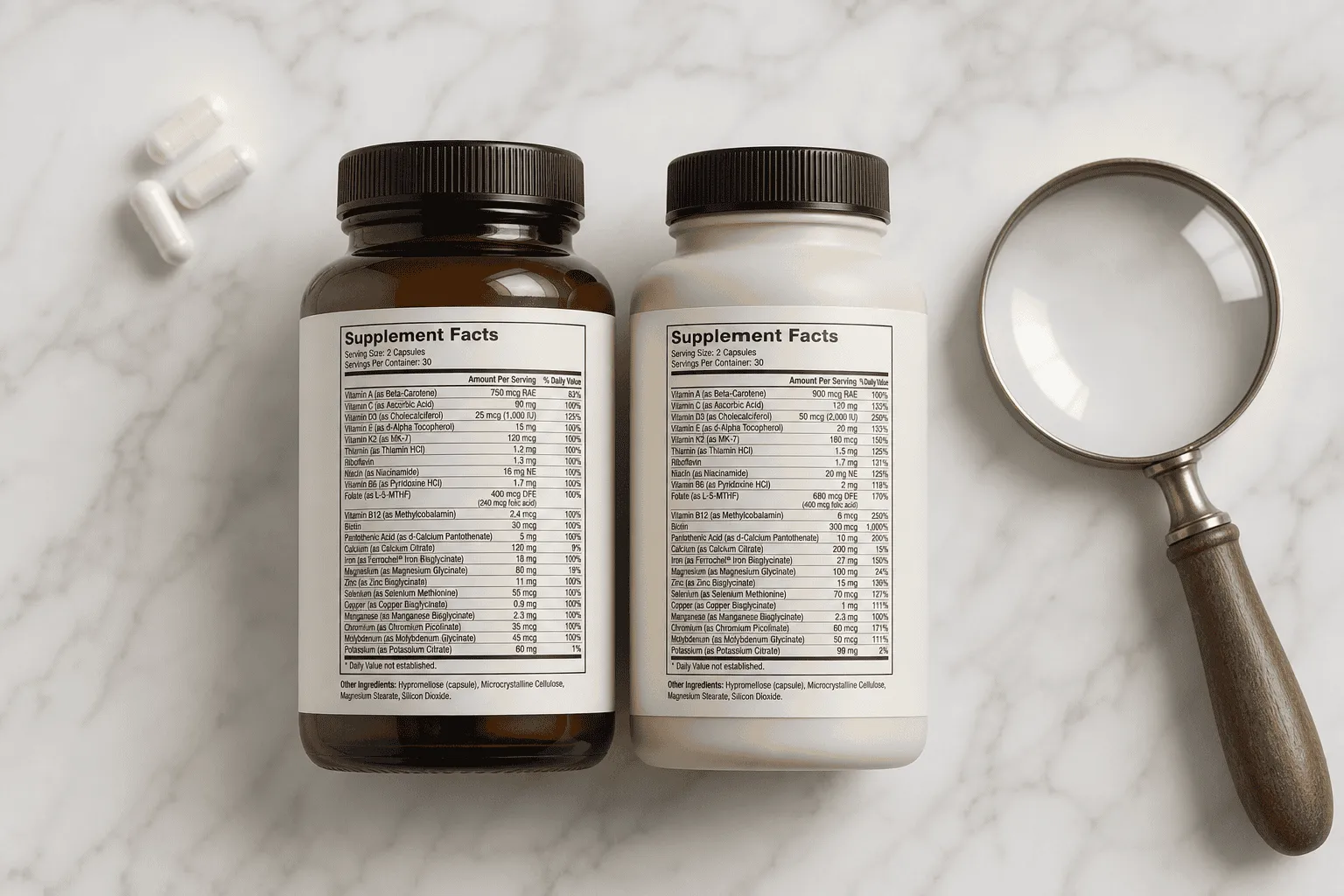
Walk into a pharmacy and look at the magnesium shelf and it can be surprisingly difficult to know what you’re actually buying.
One bottle might advertise 500 mg of magnesium glycinate. Another might contain 300 mg of magnesium citrate. A third might promise a “high-strength” magnesium complex containing several different forms.
At first glance, the product with the largest number can look like the obvious choice.
But that number may not tell you how much elemental magnesium you’re actually getting.
Understanding a magnesium label takes only a few minutes once you know what to look for. More importantly, it can prevent you from comparing products based on marketing claims rather than the information that actually matters.
1. Find the Specific Form of Magnesium
The first thing to look for is the actual magnesium compound.
“Magnesium supplements” is a category, not a single ingredient. Products can contain forms such as:
- Magnesium bisglycinate
- Magnesium citrate
- Magnesium oxide
- Magnesium L-threonate
- Magnesium malate
- Magnesium taurate
These forms aren’t interchangeable.
The compound attached to magnesium affects characteristics such as elemental magnesium content, tolerability and how the ingredient is used in supplements.
For example, magnesium citrate is commonly used as a general magnesium supplement and can have a mild laxative effect. Magnesium bisglycinate is a chelated form bound to glycine and is often chosen by people who want a well-tolerated option for regular use.
Magnesium L-threonate is a different formulation that has attracted interest because of research investigating magnesium and cognitive function.
The important point is that the form should be clearly identified.
If the front of the package says something vague such as “Magnesium Complex” or “Magnesium Ultra,” turn the bottle around and read the ingredients.
The back of the label is often much more informative than the front.
2. Don’t Confuse Compound Weight With Elemental Magnesium

This is probably the most important thing to understand when comparing magnesium products.
A label might say:
Magnesium bisglycinate — 1,000 mg
That does not mean you’re taking 1,000 mg of elemental magnesium.
The 1,000 mg refers to the weight of the entire compound. Only part of that weight consists of elemental magnesium.
The same issue applies to other forms.
This is why two products that appear to have very different numbers on their front labels may provide a much more similar amount of actual magnesium.
When comparing products, look for wording such as:
“Provides elemental magnesium: 200 mg.”
That’s the figure you can meaningfully compare between products.
A product that clearly states its elemental magnesium content is much easier to evaluate than one that leaves you to guess.
3. Understand Why Magnesium Bisglycinate Is So Common
Magnesium bisglycinate deserves particular attention because it is one of the more popular chelated forms.
The compound consists of magnesium associated with two glycine molecules. You’ll also frequently see it marketed simply as “magnesium glycinate.”
For many people, the attraction is straightforward: it is generally well tolerated and doesn’t have the same laxative reputation as forms such as citrate.
That can make it a practical choice for people who want to take magnesium regularly without specifically seeking a digestive effect.
The glycine component is another reason it appears frequently in evening-oriented supplements. Glycine has its own biological functions, including roles in the nervous system.
That doesn’t mean magnesium bisglycinate should be treated as a guaranteed sleep treatment. Evidence surrounding magnesium and sleep remains mixed, and supplement studies don’t establish that everyone will experience the same effect.
It simply illustrates why the form of magnesium matters.
4. Look at the Serving Size
Never compare bottles based purely on capsule count.
A bottle containing 120 capsules sounds like it contains more product than a bottle containing 90 capsules.
But what if the first product requires three capsules per serving and the second requires two?
The first bottle provides 40 servings.
The second provides 45.
Suddenly the comparison looks very different.
Always check:
Capsules per serving × number of capsules = approximate number of servings.
Then compare the cost per serving.
This becomes particularly important when comparing premium magnesium products. A bottle that looks expensive may actually be reasonably priced once you calculate the daily cost.
Conversely, a cheap bottle may turn out to be considerably more expensive when you account for the number of capsules required each day.
5. Check What Else Is in a “Magnesium Complex”
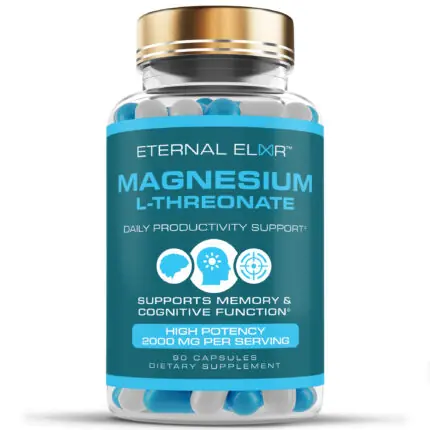
Some products contain multiple forms of magnesium.
That isn’t automatically a problem.
A combination might include citrate, bisglycinate, malate or another form. The manufacturer may have deliberately designed the formulation around particular characteristics of each ingredient.
The problem occurs when the label makes the blend sound more impressive than it actually is.
For example, a product might prominently advertise a large total magnesium-complex number while providing relatively little elemental magnesium.
Look at the individual ingredients.
If the product contains several forms, determine how much elemental magnesium the entire serving supplies and, where disclosed, how much comes from each form.
Proprietary blends can make this more difficult because the quantities of individual ingredients aren’t always disclosed.
When comparing products, transparency is useful.
6. Don’t Automatically Choose the Highest Dose
More magnesium isn’t necessarily better.
Your body needs magnesium, but taking large amounts of supplemental magnesium can cause gastrointestinal side effects, particularly diarrhoea.
The appropriate amount also depends on how much magnesium you’re already getting through food.
Adults generally need magnesium every day, and foods such as nuts, seeds, legumes, whole grains and leafy green vegetables can contribute substantial amounts.
That means a supplement doesn’t necessarily need to provide your entire daily magnesium requirement.
For someone who already has a magnesium-rich diet, a smaller supplemental amount may be perfectly reasonable.
If you’re considering higher doses, particularly for a specific health concern, it’s worth discussing the appropriate amount with a healthcare professional.
People with impaired kidney function require particular caution because the kidneys play an important role in removing excess magnesium.
7. Consider Why You’re Taking Magnesium
The “best” form depends partly on what you’re trying to achieve.
Someone looking for a straightforward nutritional top-up may have different priorities from someone specifically interested in an evening supplement.
Similarly, someone who experiences constipation may view citrate’s laxative effect differently from someone with an already-sensitive digestive system.
And someone interested in emerging research around cognition may encounter magnesium L-threonate, which has been studied for that purpose.
This is why shopping based on a generic “best magnesium” label can be misleading.
Start with the goal.
Then evaluate the forms that make sense for that goal.
If you want to compare how different formulations are positioned for sleep, focus, general supplementation and other uses, a guide to the best magnesium supplements available in Australia can provide a useful overview of the major forms and products on the Australian market.
8. Check the Manufacturer and Product Quality
The ingredient list isn’t the only thing worth examining.
Consider who made the product and whether the manufacturer provides meaningful information about quality control.
Depending on where you live and the type of product, look for information about manufacturing standards, testing and ingredient sourcing.
Be particularly cautious of dramatic claims.
A magnesium supplement doesn’t become superior simply because the packaging says “premium,” “maximum strength,” “advanced,” or “ultra.”
Marketing language is easy to create.
A transparent ingredient panel is much more useful.
If a manufacturer clearly identifies the magnesium form, elemental magnesium per serving, serving size and other ingredients, you can make a much more informed comparison.
A Quick Example: Comparing Two Labels
Imagine you’re standing in a store comparing two products.
Product A
Magnesium Glycinate
500 mg per serving
2 capsules per serving
Product B
Magnesium Bisglycinate
200 mg elemental magnesium per serving
2 capsules per serving
At first glance, Product A appears to contain more magnesium.
But the labels aren’t giving you equivalent information.
The 500 mg figure may refer to the weight of the magnesium glycinate compound rather than elemental magnesium.
Product B explicitly tells you that the serving provides 200 mg of elemental magnesium.
Without understanding that distinction, it’s easy to assume Product A is more potent.
This is precisely why the elemental magnesium figure deserves your attention.
What About Magnesium Oxide?
Magnesium oxide is a particularly good example of why the label can be misleading.
It contains a relatively high proportion of elemental magnesium by weight, which can make the numbers on the packaging look impressive.
However, magnesium oxide is generally less well absorbed than several other forms.
It also has a recognised laxative effect, which can be useful in some circumstances but isn’t necessarily what someone wants from a daily magnesium supplement.
This doesn’t make magnesium oxide universally useless.
It simply demonstrates why “highest elemental magnesium percentage” isn’t the same thing as “best supplement.”
The form, intended use and tolerability all matter.
Should You Choose Capsules, Powder or a Blend?

The delivery format is mostly a matter of practicality.
Capsules are convenient and easy to dose consistently.
Powders can be useful if you dislike swallowing capsules or want more flexibility in adjusting the amount.
Multi-form products can be convenient if you prefer a single supplement rather than buying several individual products.
But don’t let convenience obscure what’s actually inside the product.
Regardless of the format, go back to the same questions:
What form of magnesium is included?
How much elemental magnesium does the serving provide?
How many servings are in the container?
What else is included?
Does the product suit your reason for taking magnesium?
Those questions will tell you considerably more than the size of the bottle or the claims printed across the front.
A Five-Second Magnesium Label Checklist
If you don’t want to spend ten minutes standing in the supplement aisle, use this quick checklist.
1. Find the form.
Is it bisglycinate, citrate, oxide, L-threonate or something else?
2. Find elemental magnesium.
Ignore the impressive-sounding compound weight and identify the actual elemental amount.
3. Check servings.
How many capsules or scoops are required per serving?
4. Calculate the daily cost.
Don’t compare bottles. Compare the cost of a comparable daily dose.
5. Read the other ingredients.
Look for unnecessary blends, undisclosed amounts or ingredients you don’t want.
That process takes less than a minute once you’ve done it a few times.
The Label Usually Tells You More Than the Front of the Bottle
Buying magnesium doesn’t have to be complicated.
The trick is to stop treating every product labelled “magnesium” as though it were the same thing.
Magnesium bisglycinate, citrate, oxide and L-threonate can all appear on the same shelf while offering quite different formulations.
The most useful information is usually found in the small print: the specific form, elemental magnesium content, serving size and complete ingredient list.
Once you know how to read those details, comparing products becomes much easier.
And instead of buying the bottle with the biggest number or the most impressive marketing claim, you can choose based on what you’re actually getting.