Introduction
Legal recognition of disabilities plays a crucial role in ensuring equality, dignity, and access to opportunities for millions of individuals across India. To strengthen disability rights and promote inclusion, the Government of India enacted the Rights of Persons with Disabilities (RPWD) Act, 2016. This landmark legislation expands the scope of protection by officially recognizing 39 conditions and diseases as disabilities under the law.
The RPWD Act 2016 marks a significant step forward in upholding disability rights in India, providing legal safeguards, social security, and equal access to education, employment, and public services. By clearly defining the types of disabilities, the Act empowers individuals to claim their rights and access essential government benefits.
In this article, we’ll explore the complete list of the 39 legally recognized conditions, what each one means, and how this recognition impacts the lives of citizens across the country.
Overview of the RPWD Act, 2016
The Rights of Persons with Disabilities (RPWD) Act, 2016 was enacted to replace the earlier Persons with Disabilities (Equal Opportunities, Protection of Rights and Full Participation) Act, 1995. This updated law aligns India’s disability rights framework with the United Nations Convention on the Rights of Persons with Disabilities (UNCRPD), which India ratified in 2007.
The RPWD Act broadens the definition of disability and significantly increases the number of recognized conditions from 7 to 39 disabilities, reflecting a more inclusive and modern understanding of physical, mental, intellectual, and sensory impairments.
Key objectives of the Act include:
- Ensuring equality and non-discrimination
- Promoting full and effective participation in society
- Providing legal recognition of disabilities
- Ensuring access to education, employment, health care, and barrier-free environments
This legislation represents a major step in ensuring disability rights in India, offering legal remedies and support systems that empower persons with disabilities to lead independent and dignified lives.
The 39 Conditions and Diseases Listed in the Act
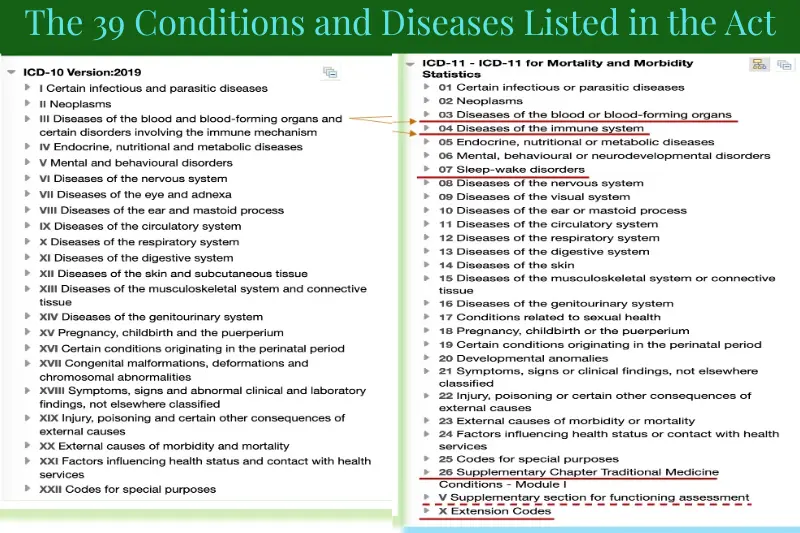
Under the RPWD Act, 2016, a total of 39 conditions and diseases have been officially recognized as disabilities. This expanded list reflects a more inclusive understanding of both visible and invisible disabilities — from physical impairments to neurological, intellectual, and blood disorders.
These disabilities are grouped into broad categories to help streamline certification, policy-making, and rights-based interventions.
Categories of Disabilities under the RPWD Act (H3)
Below is a breakdown of the recognized disabilities under each category:
Physical Disabilities
- Locomotor Disability
- Leprosy Cured Persons
- Cerebral Palsy
- Dwarfism
- Muscular Dystrophy
- Acid Attack Victims
Visual Impairments
- Blindness
- Low Vision
Hearing Impairments
- Deaf
- Hard of Hearing
- Speech and Language Disability
- Intellectual Disabilities
- Specific Learning Disabilities (SLD)
- Autism Spectrum Disorder (ASD)
Mental Behavior (Mental Illness)
Disabilities Caused by Chronic Neurological Conditions
- Multiple Sclerosis
- Parkinson’s Disease
Blood Disorders
- Hemophilia
- Thalassemia
- Sickle Cell Disease
Multiple Disabilities
More than one of the above-listed conditions
Other Identified Disabilities
These include rare or lesser-known conditions with long-term effects on functioning:
- Speech and language disability (due to organic causes)
- Chronic neurological conditions
- Multiple disabilities including deaf-blindness
Key Points to Remember:
A certified disability must typically involve at least 40% impairment for eligibility under most government schemes.
These recognized conditions enable individuals to access benefits such as reservation in education and employment, monthly pension, assistive devices, and more.
Eligibility for Disability Certificate
To access the legal protections, benefits, and entitlements under the RPWD Act, 2016, an individual must obtain an official disability certificate. This certificate serves as proof that a person has one or more of the 39 conditions and diseases listed in the Act, and meets the required threshold of disability.
Who is Eligible?
A person is eligible for a disability certificate if:
- They are diagnosed with one or more of the 39 recognized disabilities.
- The extent of disability is 40% or more, as assessed by a certified medical authority.
- The condition is long-term (chronic) and impairs full participation in society.
Types of Disability Certificates
- Permanent: Issued for lifelong disabilities or conditions that are not expected to improve.
- Temporary: Issued when the degree of disability may change with time or treatment.
How is Disability Measured?
- Disability is assessed by a medical board consisting of specialists at a government hospital or authorized center.
- Standardized guidelines are used to calculate the percentage of disability based on medical reports, tests, and physical examinations.
- For some conditions (like autism or intellectual disabilities), psychological or behavioral assessments are included.
Documents Required for Application
- Proof of identity (Aadhaar, voter ID, etc.)
- Medical reports and diagnosis records
- Passport-sized photographs
- Address proof
- Application form (available online or at hospital)
Where to Apply
- District hospitals, government medical colleges, or authorized disability assessment centers
- Some states also allow online applications via government portals like:
- Swavlamban
- State-specific e-district portals
Having a valid disability certificate is essential to access government schemes, job reservations, education quotas, and other benefits provided under the RPWD Act.
Rights and Benefits Under the Act
The RPWD Act, 2016 not only legally recognizes 39 conditions and diseases as disabilities but also guarantees a wide range of rights and benefits to persons with disabilities, aiming to promote their full inclusion and equal participation in society.
Key Rights Guaranteed by the Act
- Reservation in Employment
Persons with disabilities are entitled to at least 4% reservation in government jobs, ensuring better access to public sector employment opportunities. - Reservation in Education
The Act mandates reservations in educational institutions, including schools and higher education, to promote accessible learning environments. - Access to Health care and Rehabilitation
Persons with disabilities have the right to free or affordable health care, rehabilitation services, and access to assistive devices such as wheelchairs, hearing aids, and more. - Barrier-Free Environment
The Act requires accessibility in public buildings, transportation, and services, enabling persons with disabilities to move freely and independently. - Protection from Discrimination
Discrimination based on disability in employment, education, transport, and access to public services is prohibited. - Social Security and Welfare Schemes
Eligible individuals can receive pensions, subsidies, and financial assistance under various central and state government schemes.
Additional Benefits
- Inclusive Education Programs
Schools must provide special educators, learning aids, and adapted infrastructure. - Awareness and Sensitization
The Act encourages awareness campaigns to reduce stigma and promote a supportive social environment. - Legal Aid and Grievance Redressal
Persons with disabilities can seek legal remedies for violations of their rights through designated authorities and commissions.
The RPWD Act 2016 plays a pivotal role in empowering persons with disabilities by providing a comprehensive framework for their rights and entitlements. Recognizing these rights is crucial to building an inclusive society where everyone can contribute equally.
Conclusion
The inclusion of 39 specific conditions and diseases in the act highlights the comprehensive scope and careful consideration given to addressing a wide range of health issues. This list ensures targeted protection, support, and regulation, reflecting the act’s commitment to covering diverse medical needs and safeguarding affected individuals effectively.